
In Their Own Words: Pickles Kids on Facing a Parent’s Cancer
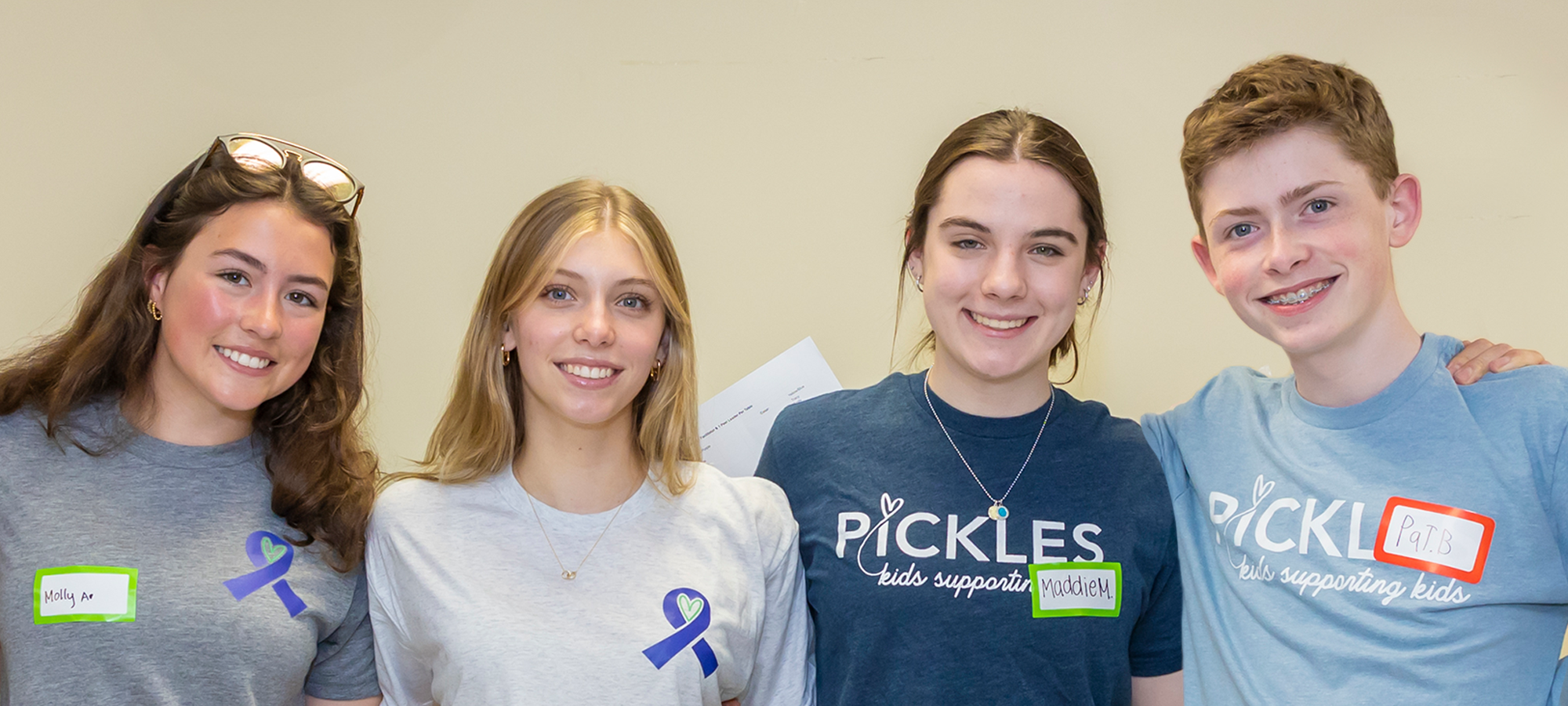
[from left] Molly, 16, has been part of Pickles since 2019; her dad has brain cancer. Francesca, 17, has been part of Pickles since 2019; her mom had stage four lung cancer and passed away in 2022, and her dad has stage three colorectal cancer. Maddie, 18, was seven when her mom was first diagnosed with a blood cancer, and 13 when her mom was diagnosed with breast cancer, which is when she found Pickles. Patrick, 15, has been part of Pickles for four years; his dad passed away from colon cancer two years ago.
Pickles Group's Chief Clinical Officer, Kelsey Mora, sat down with Molly, Maddie, Francesca, and Patrick, for a conversation unlike anything we'd done before. For the first time, we opened the floor and let the kids do the talking.
Below is what they shared, in their own words.
What's one thing that feels really sour about having a parent with cancer and one thing that maybe feels sweet that people might not expect?
Francesca: I think there's a lot of very obvious sour. I mean, for me, I lost a parent to cancer and I still had to deal with the phases of a parent with cancer. But a thing that I think is sweet is that I've gotten to meet a bunch of people who are in a very similar situation as me. And it's really nice to be able to know people that are in a similar situation because we're all able to talk about things that are similar even if we have different experiences with it, if we have parents that are diagnosed with different cancers, you can always find a common ground. And so that is one sweet that I think comes out of having a parent with cancer.
Molly: I also think that comforting common ground is such a good way to build a really amazing friendship. I've made so many friends from Pickles. Every Pickles kid I've met is genuinely one of my friends. It's really cool to see how everyone is friends and it's such a tight-knit community and that's definitely one of the highlights of this whole experience.
What's something that people often get wrong about what it's actually like to have a parent with cancer or to lose a parent to cancer?
Maddie: I feel like a lot of times people don't know how to bring it up, they don't know how to be like 'how are you doing?' or 'are you okay?' because it's a very delicate and fragile topic and I think honestly through Pickles I've really understood that it's a great thing to go up to someone and be like ‘how are you doing?’ or ask them about something else... If they play a sport, ask them how that sport is going. A lot of people think that it can be really uncomfortable to talk about. While it is a sad thing to talk about, it's also a wonderful thing to know that people genuinely care about what you're going through and care about how you're doing.
Patrick: I've noticed most people usually try to avoid buzzwords like 'dad' or 'parents' or 'family' because they think I could feel hurt by that or I may feel some pain from hearing that. But in fact, I think that I enjoy hearing other people talk about their parents, talking about their experiences. It's not bad to talk to someone who's lost a parent to cancer about your parents. Try to kind of normalize it, act how you would if it didn't happen, because that kid wants everything to kind of return back to normal. And by avoiding certain areas, you're in fact making it more awkward and or worse for them to have conversations and open up to you.
Is there anything that adults think is helpful that actually isn't? Any advice you'd give to parents?
Francesca: There's times where I'm just really upset about my mom's cancer or my dad's cancer that I want to talk to my dad about it, but I'm not necessarily looking for advice. It's more of I just want to say ‘this sucks,’ but I'm not necessarily looking for my dad to be like, 'Well, have you tried doing this? Do you want to do that? Will this make you feel better?' Sometimes I'm really just looking for a chance to be able to say I'm feeling really upset right now, I'm having a bad day. I'm not always looking for an answer to my problem. There's a lot of times where, if it's my mom's cancer-versary or something like that, I have tons of people that are checking in on me, asking if I'm doing okay, and all of that is super sweet and I love all of that. But then there's other times where I just want to sit and say this really sucks. So, I think not always giving your kid a solution if they're not looking for one, if that makes sense.
Molly: Francesca just reminded me of this analogy that really resonated with me. I heard it on a podcast. This guy was talking about his grief and I don't know what the context was, but he said ‘when I was really depressed, what didn't help was the people trying to dig me out of the hole I was in, it was the people who tried to come in and sit with me… so come and sit in the hole with me for a while’ which really resonated with me and made me feel so seen. I feel like for me personally, sometimes I just want, like Francesca said, my feelings to be validated and I don't want a solution, and I don't want people to tell me it's going to be okay and sometimes I do need that but sometimes I just want people to be like yeah it does really suck and yeah what you're going through is really hard.
What's it like to be around other kids who truly understand what you're going through, even if your situations are different?
Patrick: I'm going to be completely honest. It's very comforting. It's amazing to know that I get to be around people who understand what I've been through whether they've had it happen two years ago or going through it now because especially like the older ones which is what my hope to try and do as a peer leader is it kind of I've had amazing older peer leaders kind of be there for me in my time of need. They were like ‘I've been through this, here's what I did.’ Just that comfort, the ability to know that all these people know exactly what I've been through and they all can give their input. They know exactly what you're feeling. So just that comfort, the older person helping the younger person, it's just really helped me out in my time of need.
Francesca: My best example is me and Molly. I mean, I have known Molly since 2019, and we have very different stories. Her dad was diagnosed, my mom was, and then my mom passed away. But there's still so many similarities since I did have a parent with cancer. And so I know times when she's feeling upset about something, I know what that feeling feels like and I can still resonate with that. But then I still feel totally comfortable saying like, 'Oh, I'm really upset because of my mom and I miss her a lot.' and it doesn't feel like there's any disconnect even though she hasn't experienced that because her and I have gotten to know each other so well over time. It's kind of like she just gets me and she gets what I need in the moment and she knows she can kind of read how I'm feeling about certain things and if I want to talk about it or if I just want to say I'm really upset about this but like let's go do something fun instead so we don't have to think about it. Although we have two very different stories, cancer is still something that connects us. And I said before, you can always find similarities within everyone's stories and just the fact that there is that commonality makes it so much easier to talk about things.
Molly: I totally agree and I think that Pickles kind of creates, even with different experiences, a go-to person and a go-to group of people to be able to talk about this with because I feel like being a teenager and even in middle school and elementary school, it's really hard to go to your friends and be like 'I'm struggling, can you please help me?' and having Pickles be a designated group of people where you can definitely 100% go to these people to talk about this has been the most amazing thing. The other amazing addition is that all these people are some of my really close friends and I've gotten to know all the different types of amazing people that I would totally go to for this type of thing and I think even with different experiences. Being able to have that go-to person or group of people is so amazing.
What would you want a younger kid who’s going through this to know?
Patrick: Find a support group like Pickles. The effect of having kids who know what you've been through, who've experienced the exact same thing and can offer wisdom is beyond the simple impact. It has changed my life. I've been with this group for four years and throughout these years I've managed to meet with these people, grow with these people, and some of them I've become really good friends with and some of them I talk to fairly frequently. The effect of having a support group like Pickles is astronomical.
Maddie: I often hear the phrase ‘you get out what you put in.’ I don't think that that's true at Pickles, because I don't think that there's a limit to how much you can receive or how much you can get out of this program. There are absolutely no expectations when it comes to opening up about your emotions. You could open up on day one. You could open up on day 100 and there would still be the same passionate, welcoming, loving sort of reaction to anything that you want to talk about. I just want any child, any parent to know that there are absolutely no expectations when it comes to joining Pickles, Pickles is here to support participants. At its core, it is a place for people to come together and support each other in the ways that they need.
Francesca: I really want to just emphasize what Maddie's saying. You don't have to want to talk about it. You're totally able to just go and listen and you will still get so much out of it. For kids that might be nervous to come, you don't have to have your camera on. You don't have to turn your mic on. There's no participation grade. You're totally able to just sit and listen. And if you don't get anything out of it, I say you come back another week because we do a different activity every single time and there’s always something new and fun. And for parents, if you have a younger kid who's nervous, you can totally sit with them and just see if that helps them get acclimated because I know that sometimes it can be kind of scary. It's been so great to watch the younger kids figure out that they're all there for the same reasons. I work in a Pickles Jar of younger kids and at one of our last calls they kind of were all connecting the dots that they all had a parent that passed away. I just thought that it was so beautiful that everyone was like, 'Oh, my mom passed away of this. Oh, my dad passed away of that same cancer.' and everyone was kind of connecting on that level while we're doing a fun scavenger activity.
A huge thank you to Molly, Maddie, Francesca, and Patrick for generously sharing their experience and for being incredible Peer Leaders to the next generation of kids facing a parent's cancer.
No matter where you are on this journey, Pickles Group has a place for your family.
We offer free, virtual youth programs for kids and teens ages 6–18. Our Connect Over Cancer program is a 5-week peer support group that helps kids build real friendships, coping skills, and learn about cancer. For families looking for ongoing support, Pickles Jars offers year-long, monthly small groups — including jars specifically for kids who have lost a parent to cancer.